
Structural Primitives: The Mechanics That Make Symbols Move
Why symbols are not the deepest layer of symbolic reality

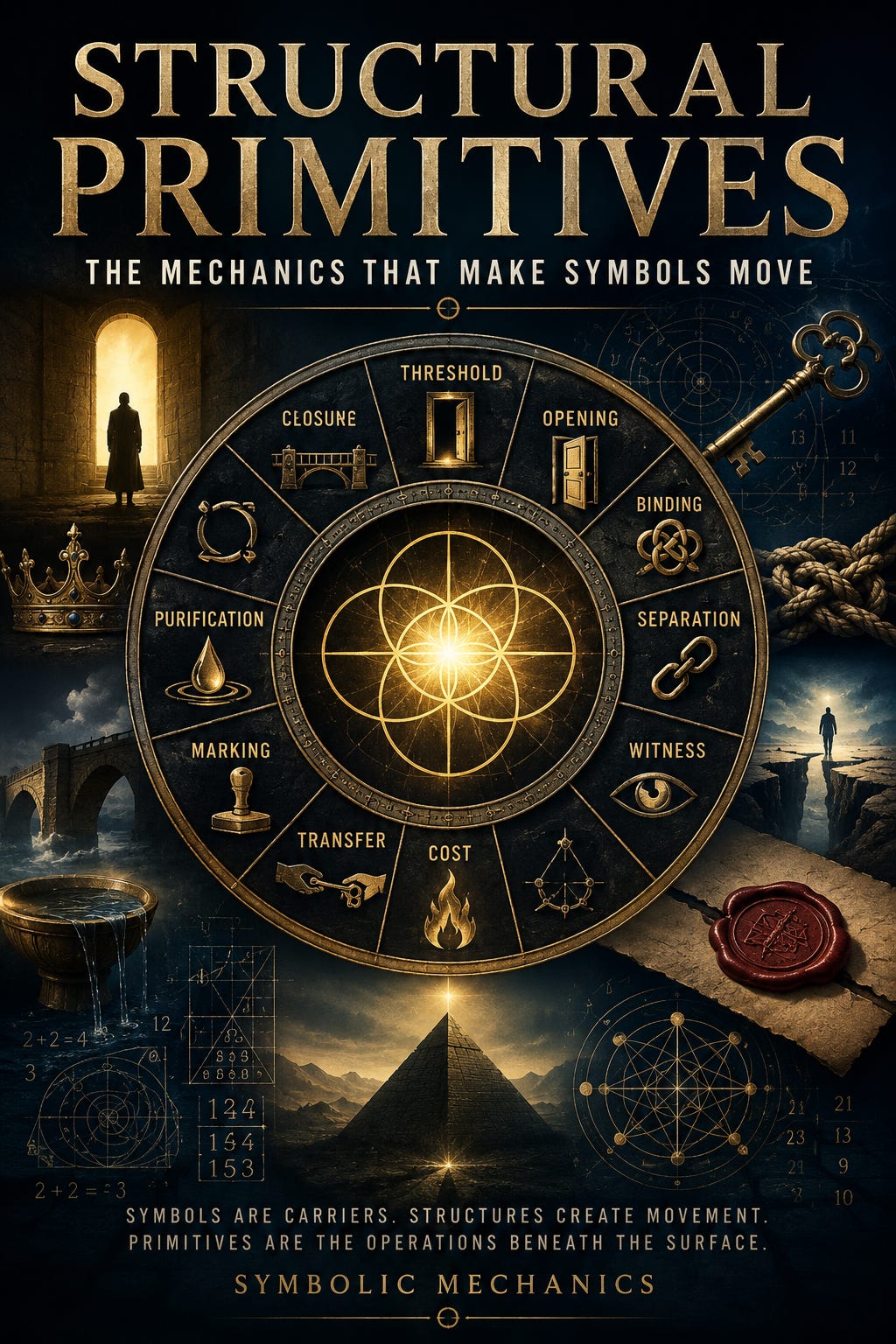
Public spectacles, rituals, brands, myths, monuments, slogans, numbers, personal anchors, and cultural events all run on deeper mechanics than the visible symbols themselves.
A coronation, a protest chant, a religious gesture, a national flag, a product logo, a repeated number, a timed ritual, and a personal anchor may look different on the surface. But beneath the surface, they often move through the same repeatable operations.
They open. They close. They bind. They separate. They mark. They crown. They purify. They transfer. They witness. They demand cost. They create passage.
This is why symbolic operations cannot be understood by asking only what a symbol “means.”
Most symbolic interpretation begins with the wrong question:
What does this symbol mean?
That question is useful, but it is not deep enough.
A symbol can mean many things at once. A serpent can mean wisdom, deception, healing, danger, renewal, temptation, poison, medicine, immortality, or hidden knowledge. A crown can mean authority, vanity, inheritance, oppression, legitimacy, conquest, or divine appointment. A bridge can mean transition, connection, danger, exile, access, return, or escape.
The symbol does not decide which meaning is active.
The structure does.
This is why symbolic interpretation becomes unstable when it depends only on meanings. The same symbol can support five different interpretations, and all of them may sound plausible. To make symbolic work precise, we need a deeper unit than the symbol.
That deeper unit is the structural primitive.
A structural primitive is not what a symbol means.
It is what a symbol is doing.
A bridge may carry the meaning of transition, but the primitive is crossing. A door may carry the meaning of opportunity, but the primitive is threshold or access. A crown may carry the meaning of authority, but the primitive is elevation, succession, or transfer of authority. A bath may carry the meaning of cleansing, but the primitive is purification. A public vow may carry the meaning of commitment, but the primitives are binding and witness.
This distinction is foundational.
Symbols are visible carriers. Meanings are associations. Structural primitives are operations.
They are the mechanics beneath the image.
A symbol can sit still in the mind as an idea. A primitive moves. It opens, closes, binds, separates, crosses, marks, crowns, witnesses, purifies, sacrifices, transfers, returns, grants access, or denies entry.
That is why structural primitives matter.
They are the mechanics that make symbols move.
Symbols Are Carriers, Not Engines
A symbol is a carrier of meaning. It can hold associations, memories, traditions, emotions, myths, correspondences, numbers, histories, and cultural charges.
But a symbol is not automatically an engine.
A symbol becomes active only when it enters a structure and begins performing a function.
Think of a key.
A key can symbolize access, mystery, knowledge, secrecy, ownership, authority, permission, hidden treasure, or locked potential. But those meanings are only the field of possibility. The mechanic depends on what the key is doing.
A key being handed to someone is transfer.
A key being turned in a lock is access.
A key being lost is blocked access or separation.
A key being found is recovery or opening.
A key being copied is duplication or delegated access.
A key being broken is closure, denial, or severed access.
Same symbol. Different primitive. Different mechanic. Different trajectory.
This is the first correction Symbolic Mechanics makes:
Do not stop at the symbolic object. Find the operation.
The object is the visible layer.
The operation is the moving layer.
Symbol, Meaning, Function, Movement
To interpret clearly, we have to separate four layers that often get collapsed into one:
symbol, meaning, function, and movement.
The symbol is the visible, audible, numerical, spatial, or behavioral carrier. A crown, bridge, flame, number, phrase, gesture, color, location, date, repeated object, body posture, or public ceremony can all function as symbols.
The symbol is what appears.
Meaning is the field of associations attached to the symbol. A crown may mean authority, royalty, legitimacy, ambition, inheritance, hierarchy, vanity, conquest, or divine appointment.
Meaning answers:
What can this symbol suggest?
This layer matters, but it is not enough.
Function is what the symbol is doing inside a specific structure. Is the crown being placed on someone, removed from someone, hidden, broken, inherited, displayed above a throne, mocked in a parody, or passed to a successor?
Each context changes the function.
Function answers:
What operation is being performed?
This is where structural primitives live.
Movement is the direction created by the function. If the crown is placed on someone, the movement may be elevation. If the crown is removed, the movement may be dethronement. If the crown is inherited, the movement may be succession. If the crown is mocked, the movement may be humiliation or inversion.
Movement answers:
Where is this structure going?
These four layers must not be confused. A symbol can have many meanings, but in a given structure, it performs a narrower function. That function produces movement. And movement, if repeated across time, can become a line.
What Is a Structural Primitive?
A structural primitive is a repeatable symbolic operation.
It is the functional unit beneath symbols, events, gestures, rituals, narratives, environments, numbers, and patterns.
A structural primitive is not the object, the decoration, the mood, or the association cloud around the symbol. It is the operative action beneath the symbolic layer.
Here are several major primitives:
Threshold: a boundary between states.
Crossing: movement from one state, space, identity, or phase into another.
Opening: access becoming possible.
Closure: a cycle sealing or an opening ending.
Reversal: direction, meaning, role, expectation, or polarity being inverted.
Binding: two things being joined into obligation, identity, memory, or function.
Separation: a previous bond, state, role, or attachment being cut.
Witness: an act becoming visible, recorded, socially recognized, or field-confirmed.
Cost: weight being added through sacrifice, risk, effort, discomfort, discipline, exposure, time, money, or reputation.
Transfer: authority, value, burden, attention, identity, permission, or power moving from one carrier to another.
Marking: something being claimed, indexed, distinguished, remembered, sealed, or set apart.
Purification: interference being removed before access, consecration, or function.
Consecration: an ordinary thing being set apart for a specific purpose.
Ascent: elevation, rank, expansion, mastery, authority, or climb.
Descent: embodiment, fall, humiliation, grounding, exposure, or contact with lower layers.
Return: a pattern completing a loop and coming back altered.
Exchange: one thing being traded, replaced, substituted, paid, or reciprocated.
Containment: a force, meaning, identity, or action being bounded.
Release: a bounded force, identity, action, or pattern being discharged, surrendered, or sent outward.
Access: entry, permission, contact, passage, opportunity, or entry-right being granted, denied, tested, or requested.
These are not merely themes. They are symbolic verbs.
A symbol is often a noun. A primitive is often a verb.
The crown is the noun. Crowning is the operation.
The door is the noun. Entering is the operation.
The bridge is the noun. Crossing is the operation.
The mark is the noun. Marking is the operation.
The offering is the noun. Cost is the operation.
This is the turn from symbolic interpretation to Symbolic Mechanics.
We are no longer only asking what something means.
We are identifying what it does.
The Same Symbol Can Carry Different Primitives
A single symbol can carry different structural primitives depending on its placement, sequence, timing, and context.
This is why fixed symbol dictionaries are useful but limited. They give possible meanings, but they do not always identify the active operation.
A bridge can carry the primitive of crossing when someone moves from one side to another. It can carry connection when two separated places are joined. It can carry danger when passage is unstable. It can carry access when it allows entry into a new territory. It can carry separation when someone remains on one side and refuses to cross. It can carry return when someone crosses back to a former place changed.
The bridge is the same symbol. The primitive depends on the structure.
A flame can carry purification when it burns away impurity. It can carry destruction when it consumes a structure. It can carry illumination when it reveals what was hidden. It can carry sacrifice when an offering is consumed. It can carry transmission when one flame lights another. It can carry danger when it threatens containment.
Same flame. Different operation.
A door can carry threshold when it separates states. It can carry access when it opens. It can carry denial when it remains locked. It can carry closure when it shuts behind someone. It can carry invitation when someone is welcomed through it. It can carry exclusion when someone is kept outside.
Same door. Different primitive.
A lion can carry guardianship when placed at a gate. It can carry authority when attached to a throne. It can carry challenge when it appears before an act requiring courage. It can carry domination when used as a symbol of conquest. It can carry witness when positioned as an observing figure during an initiation. It can carry identity transfer when someone takes the lion as an emblem.
Same lion. Different mechanic.
This is why the question must shift from:
What does this symbol mean?
to:
What is this symbol doing here?
That one word, here, matters.
Because the active primitive is determined by placement, relation, sequence, and direction.
Structural Primitives Are the Grammar Beneath Symbols
Symbols are like vocabulary.
Structural primitives are closer to grammar.
A word can mean many things, but grammar tells you how the word is functioning in the sentence. The word “light” can be a noun, adjective, or verb.
A light can shine. A bag can be light. Someone can light a candle.
Same word. Different function.
Symbols work the same way.
The visible symbol is not enough. You have to identify its position, action, relation, direction, and role inside the larger structure.
A crown above a head is not the same as a crown under a foot.
A flame in a temple is not the same as a flame consuming a house.
A bridge before a decision is not the same as a bridge after a return.
A ring placed on a hand is not the same as a ring removed from a hand.
A mark given publicly is not the same as a mark hidden privately.
Structural primitives are the grammar that tells us what symbolic elements are actually doing.
Without primitives, symbols remain loose.
With primitives, symbols become readable as structure.
Structural Primitives Exist in Numbers Too
Structural primitives are not limited to visible symbols, objects, gestures, places, or events.
They also appear in numbers.
This matters because numbers are often treated as fixed symbolic labels. One number means completion. Another means order. Another means judgment. Another means chaos. Another means divine structure.
These associations can be useful, but they are still only one layer.
A number is not only read by what it traditionally means. It is also read by what it does structurally.
A number can divide, double, mirror, complete a sequence, mark a threshold, reduce, expand, return to itself, create symmetry, create imbalance, bind separate parts into a whole, or reveal hidden proportion.
This means numbers can carry structural primitives the same way objects can.
The number is the visible carrier. The primitive is the operation moving through it.
For example, 2 can carry separation, polarity, reflection, opposition, pairing, or witness.
3 can carry synthesis, mediation, triangulation, emergence, or stability through relation.
4 can carry structure, foundation, enclosure, order, territory, or material grounding.
7 can carry completion, cycle, sacred order, testing, or a threshold between visible and invisible structure.
8 can carry return, loop, renewal, exchange, infinity, or power through circulation.
9 can carry culmination, ending, fullness, harvest, or closure before reset.
10 can carry completion of one order and entrance into another.
But even here, meaning is not enough.
The structure matters.
11 is not only a gateway number or intensified number. Structurally, it can behave as duplication, parallel pillars, mirrored ones, intensified singularity, or threshold through paired verticals.
12 can behave as ordered completion: months, tribes, apostles, zodiacal divisions, clock structure, governmental order, or full-cycle administration.
13 can behave as overflow beyond established order, the step past twelve, disruption of a completed system, or death and rebirth after a closed cycle.
The number is not just a label. It is a structure, and structure creates movement.
A number like 144 does not only carry meaning because traditions assign meaning to it. Structurally, it carries square, order, multiplication, enclosure, and intensified foundation. It is 12 × 12, which means ordered completion multiplied by itself. It can behave as a grid, a perfected framework, or a complete structure made repeatable.
A number like 153 is not only significant because of biblical association. Structurally, it is also the 17th triangular number, meaning it contains accumulation, gathering, sequence, and totalized increase. It does not merely signify fish or miraculous catch. Structurally, it behaves as gathered abundance.
This is how numbers become mechanical.
The question is not only:
What does this number mean?
The deeper question is:
What operation is this number performing?
Is it completing, dividing, doubling, gathering, mirroring, reducing, expanding, closing, opening, crossing a threshold, creating a grid, forming a loop, or binding parts into a whole?
This keeps numerical interpretation from becoming random association. The number must be read by its structure, not only by its symbolic reputation.
A number can be treated the same way as any other symbol: the number is the carrier, its traditional meaning is the association, its mathematical form reveals function, and its repeated appearance across time can become a line.
If a number appears once, it may be noteworthy.
If it repeats, it may become a theme.
But if the same numerical structure begins organizing events, decisions, timing, behavior, and feedback, then it may be part of an active line.
The primitive is not “the number.”
The primitive is the operation the number is carrying.
This is why numbers matter in Symbolic Mechanics. Not because numbers are decorative codes pasted onto reality, but because numbers can reveal structure.
And structure is where symbols begin to move.
What Is an Active Line?
Once a structural primitive gains continuity across time, it can become an active line.
An active line is not merely a repeated symbol. It is a repeated operation.
A cleaner definition:
An active line is a structural primitive extended through time with continuity, direction, and effect.
This means the surface symbols may change while the underlying operation remains the same.
You may not keep seeing the same object.
You may keep encountering the same function.
That is the key.
For example, the symbols may be keys, doors, passwords, gates, invitations, entryways, locked rooms, applications, openings, and blocked paths. The repeated symbol is not identical, but the primitive may be consistent:
access.
If that access pattern repeats across time, begins shaping interpretation, and starts producing decisions around entry, denial, permission, or passage, then access has become an active line.
Not because keys are magically important. Not because doors always mean the same thing. Because the operation of access is repeating.
The primitive has gained continuity.
That is a line.
A Line Is Not a Theme
This distinction is critical.
A theme is something that repeats in perception.
A line is something that repeats as an operation with direction.
A theme says:
I keep noticing access symbols.
A line says:
Access is organizing the sequence.
A theme says:
I keep seeing bridges.
A line says:
Crossing is being repeated across decisions, locations, and events.
A theme says:
Flames keep appearing.
A line says:
Purification, destruction, illumination, or sacrifice is the active operation, and it is repeating.
A theme is observation. A line is structure in motion.
A theme may be interesting, but a line begins to organize events. A theme may sit in the mind, but a line starts pulling behavior, timing, interpretation, and feedback into a shared direction.
That is why this work has to stay disciplined.
Not every repeated symbol is an active line. Not every interesting coincidence is an active line. Not every emotional charge is an active line.
A line requires continuity, direction, and effect.
How to Identify an Active Line
To identify an active line, do not begin by asking whether the symbols match perfectly.
Ask whether the operation matches.
Use this sequence:
Carrier → Primitive → Direction → Continuity → Effect
The carrier is the surface layer: the visible symbols, events, phrases, places, numbers, gestures, objects, or situations appearing. Write them down without forcing interpretation.
The primitive is the shared function beneath the carriers. Are they all pointing toward access, closure, crossing, witness, transfer, purification, cost, separation, binding, return, ascent, descent, containment, or release?
The direction reveals the vector. Is the operation opening or closing, ascending or descending, binding or separating, entering or exiting, increasing pressure or releasing pressure?
The continuity tells you whether this is repeating across time. Does it appear in different forms but keep the same underlying function? Does it connect across days, locations, decisions, conversations, tasks, obstacles, or outputs?
The effect tells you whether the operation is active. Does it change attention, alter decisions, provoke action, reveal resistance, create opportunity, produce feedback, or reorganize the next step?
The test is not:
Did I see something strange?
The test is:
Is the same operation moving through time and producing effects?
That question protects the work from noise.
It turns observation into method.
Example: Access as an Active Line
Suppose someone enters a period where the following symbols and events keep appearing:
a locked door, a forgotten password, a key found in an old drawer, an invitation from someone unexpected, a gate left open, a declined application, a new account approval, a conversation about permission, a bridge crossed on the way to an important meeting, and a phrase repeating in the mind:
enter clean
A weak interpretation would collect meanings separately.
Door means opportunity. Password means secrecy. Key means knowledge. Gate means passage. Bridge means transition.
That may be fine, but it stays scattered.
A structural reading asks:
What operation is repeating?
The answer may be access.
Access granted. Access denied. Access forgotten. Access recovered. Access requested. Access tested. Access crossed.
Now the pattern is no longer a pile of symbols.
It has a spine.
If the access pattern begins influencing decisions, the line becomes more active. The person may start asking:
Where am I seeking entry? What door is opening? What door is blocked? What permission am I waiting for? What access do I already have but have not used? What is the cost of entry? What password, key, request, or threshold is required?
Now the primitive has become operational.
It is no longer just observed.
It is structuring action.
That is an active line.
Example: Closure as an Active Line
Closure appears when a cycle, opening, relationship, task, phase, identity, or pattern is being sealed.
Possible carriers include a door shutting, a final payment, a last conversation, a pen running out of ink, a charger dying, a candle burning down, a file being submitted, a room being cleaned out, an old object breaking, a subscription ending, a final receipt, or a task finally being completed after delay.
If these appear once, they may only be ordinary events.
If they repeat across time and begin structuring decisions, closure may be active.
The surface symbols may differ, but the operation is the same:
sealing.
The question becomes:
What is ending? What cycle is trying to close? What opening is no longer available? What obligation needs to be completed? What object, habit, place, or identity has reached its last use? What needs to be formally sealed so the next phase can begin?
A closure line is not proven because one thing breaks or one door shuts.
It becomes stronger when closure begins shaping timing, behavior, interpretation, and output.
A person may notice several unrelated events: a pen dies while writing, a charger stops working, an old account closes, a delayed task finally gets submitted, and a conversation ends with unusual finality.
A weak interpretation would treat each event separately.
The pen means blocked communication. The charger means low energy. The account closing means loss. The conversation ending means rejection.
That may be possible, but it stays scattered.
A structural reading asks:
What operation is repeating?
The answer may be closure.
The line becomes more active if those events begin producing actual decisions: finish the article, clean the workspace, end the loose obligation, stop reopening the old cycle, seal the task, archive the old material, or prepare the next container.
Now closure is no longer just observed.
It is organizing behavior.
That is an active line.
How Structural Primitives Become Active
A structural primitive can exist without becoming active.
A door may carry threshold. A ring may carry binding. A flame may carry purification. A number may carry completion. A bridge may carry crossing.
But the primitive becomes active only when it begins altering the field.
This is where activation mechanics enter.
Structural primitives are the operations. Activation mechanics are the conditions that make those operations powerful.
A primitive becomes active through several forces.
1. Constraint
The primitive narrows perception.
It makes certain interpretations, decisions, and possibilities more likely.
Access makes the field organize around entry and denial. Closure makes the field organize around endings and seals. Crossing makes the field organize around passage and transition. Cost makes the field organize around weight, sacrifice, and payment.
Constraint answers:
What does this operation make more likely to be noticed or chosen?
2. State Shift
The primitive alters internal condition.
It changes seriousness, attention, emotion, posture, readiness, pressure, or identity.
A threshold can create alertness. A vow can create gravity. A mark can create ownership. A crown can create elevation. A bath can create separation from the previous state.
State shift answers:
What condition does this operation produce in the observer or participant?
3. Motor Coupling
The primitive attaches to the body.
It becomes gesture, posture, breath, rhythm, step count, speech, touch, repetition, or embodied action.
Crossing becomes walking. Purification becomes bathing. Binding becomes tying, signing, wearing, or speaking a vow. Marking becomes writing, stamping, sealing, or placing. Cost becomes fasting, giving, risking, enduring, or showing up.
Motor coupling answers:
What does this operation make the body do?
4. Sequencing
The primitive unfolds through time.
It has before, during, and after.
Purification before consecration. Cost before access. Threshold before crossing. Witness before legitimacy. Closure before return. Marking before ownership.
Sequencing answers:
Where does this operation sit in the larger progression?
5. Structural Resonance
The primitive repeats across layers.
It appears in different forms while carrying the same underlying operation.
Access may appear as a key, password, invitation, gate, approval, door, opening, permission, bridge, or entryway.
Closure may appear as a final payment, dead battery, broken pen, last conversation, submitted file, locked door, archive, seal, ending, or completed task.
Binding may appear as ring, contract, knot, vow, signature, clasp, seal, or shared name.
Structural resonance answers:
What deeper operation is repeating beneath different carriers?
6. Attractor Formation
The primitive begins gathering related signals, decisions, obstacles, opportunities, and feedback around itself.
At this point, the primitive is no longer merely noticed.
It is organizing the field.
An attractor is not a message. It is an organizing center.
This does not mean every random event belongs to the line. It means the operation has gained enough continuity and charge that related events begin clustering around its structure.
Attractor formation answers:
Is this operation pulling attention, behavior, timing, and feedback into a shared field?
7. Conversion
The primitive produces output.
This is the proof layer.
A line that never converts may still be meaningful, but it remains weak as an operation.
Conversion may appear as:
a decision made
a behavior changed
a conversation opened
a boundary crossed
an opportunity received
a cycle closed
a task completed
an identity reinforced
a relationship shifted
a material result produced
an article written
a protocol refined
an environment reorganized
Conversion answers:
What did this operation produce?
This is where Symbolic Mechanics becomes practical.
Not every signal needs to be chased. Not every symbol needs to be interpreted. The question is whether the primitive produces movement and conversion.
Diagnostic Table: From Symbol to Line
Use this when analyzing a symbol, event, number, place, phrase, ritual, public spectacle, or personal anchor.
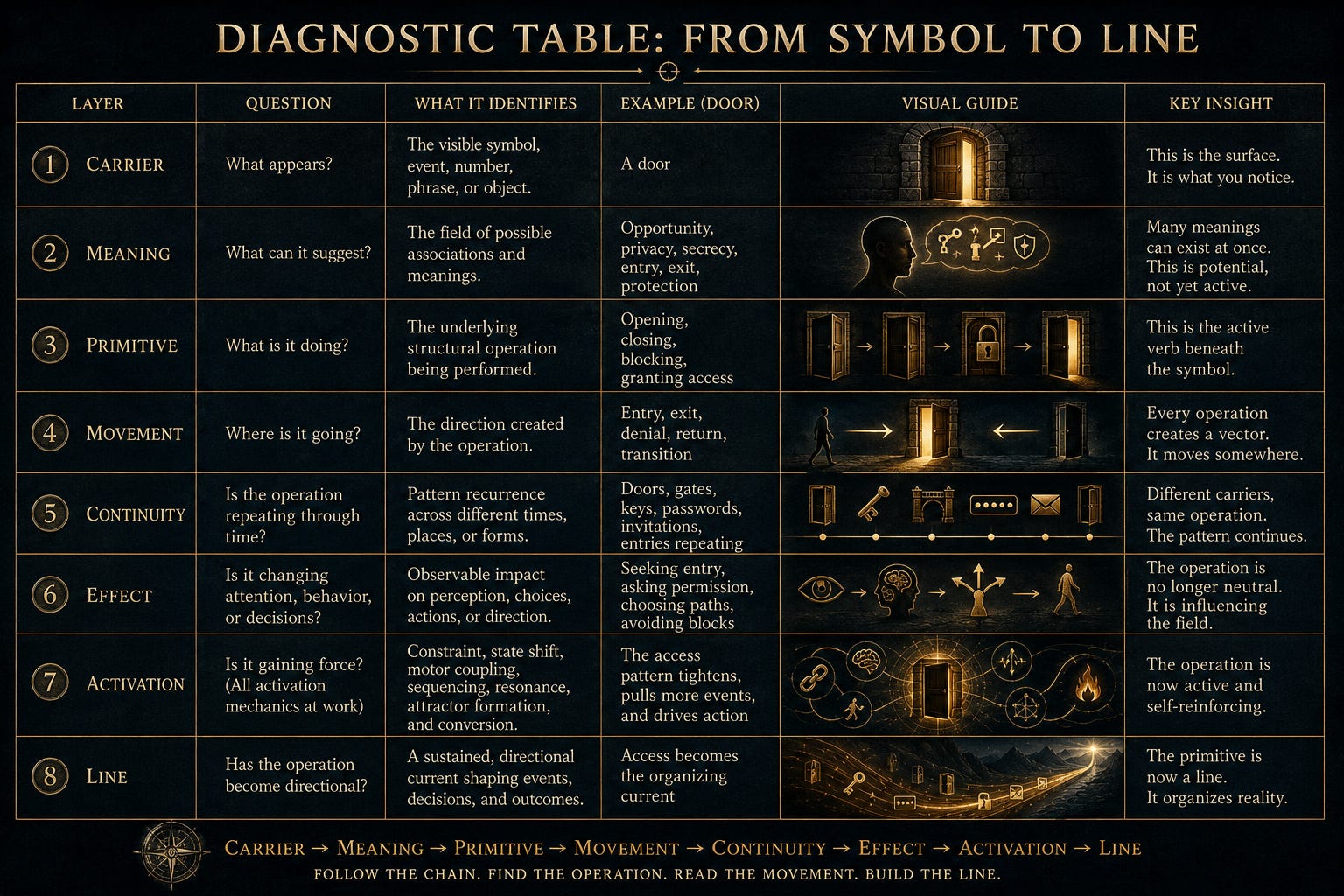
This table is important because it prevents symbolic collapse.
Do not jump from symbol to meaning too quickly. Do not jump from coincidence to conclusion. Do not confuse emotional charge with structural continuity.
Follow the chain:
Carrier → Meaning → Primitive → Movement → Continuity → Effect → Activation → Line
That is the cleaner method.
Why Rituals and Public Spectacles Run on Structural Primitives
Rituals and public spectacles do not work because every person consciously understands every symbol inside them.
They work because symbols are arranged into operations.
A ritual may use candles, robes, chants, cups, thresholds, vows, titles, processions, sacrifices, seals, numbers, gestures, and public declarations. A spectacle may use flags, celebrities, architecture, music, costumes, slogans, victims, villains, dates, colors, and media repetition.
But these are still carriers.
The deeper question is not only:
What symbols are present?
The deeper question is:
What operations are being performed?
Is the event creating purification before entry? Is it creating threshold before transition? Is it creating witness before legitimacy? Is it creating cost before access? Is it creating binding through vow, oath, grief, celebration, allegiance, name, mark, or shared identity?
Is it creating separation from a previous state or dividing the public into opposing identities? Is it creating transfer of authority, blame, sympathy, legitimacy, burden, attention, guilt, or permission? Is it creating consecration by setting apart a person, place, cause, object, date, or role as sacred, cursed, historic, heroic, untouchable, or significant?
This is why ritual structure matters more than ritual decoration.
A robe does not make a ritual.
A candle does not make a ritual.
A symbol on the wall does not make a ritual.
The operation makes the ritual.
The same principle applies to public spectacles. A public event may present itself as entertainment, news, politics, mourning, celebration, scandal, protest, ceremony, or emergency. But beneath the surface narrative, it may still be organizing attention through structural primitives.
A spectacle can bind a population through shared emotion. It can separate groups into opposing identities. It can transfer blame from one figure to another. It can mark a date as historic. It can consecrate a victim, villain, hero, movement, object, or cause. It can create threshold by dividing time into “before” and “after.”
This is why different public events can look unrelated while running on the same deeper template.
The outer form changes. The operation repeats.
A political ceremony, celebrity scandal, mass media ritual, corporate launch, national tragedy, sports spectacle, or initiation drama may all use different symbols while performing the same primitives.
This is also why symbolic operations become difficult to see from the surface. People argue over the image, the story, the morality, or the politics while the deeper operation continues underneath the argument.
The cleaner question is:
What primitive is being installed, repeated, amplified, or converted?
That question does not replace ordinary analysis. It adds another layer. It helps separate the visible presentation from the operative structure.
The surface gives the event its appearance.
The primitive reveals its movement.
The Unifying Principle
If this entire framework is compressed into one sentence, it is this:
Symbols carry meaning, but structural primitives create movement.
A symbol can suggest many things, but a primitive performs a specific operation.
A crown may suggest authority, royalty, vanity, conquest, legitimacy, or inheritance. But when the crown is placed on a head, the operation is more precise: elevation, transfer, succession, recognition, or consecration. The meaning field may be wide, but the performed structure is narrower.
This is the key distinction.
Meaning expands.
Function narrows.
Movement directs.
A symbol can remain decorative. A primitive acts. A symbol can sit in the mind as an idea. A primitive can move through time, repeat across events, and become a line.
That is the mechanics of symbolic motion.
Not loose association.
Not surface aesthetics.
Structure.
The Foundation of Symbolic Mechanics
Structural primitives give Symbolic Mechanics a disciplined way to move beyond surface-level interpretation.
They explain why a symbol can mean many things but only perform certain operations in a given structure. They explain why fixed symbol dictionaries are useful but insufficient. They explain why numbers must be read structurally, not only associatively. They explain why a repeated theme is not automatically an active line. They explain why rituals and public spectacles can reorganize attention without every observer consciously understanding the symbolism.
They also give the work a practical test.
The surface question is:
What does this symbol mean?
The deeper question is:
What primitive is operating?
The line question is:
Is this operation repeating through time with continuity, direction, and effect?
The engineering question is:
How can this operation be shaped, tested, strengthened, and converted?
This is where Symbolic Mechanics begins: not with passive interpretation, decoration, or belief alone, but with the operations beneath symbols.
Symbols are visible.
Meanings are possible.
Primitives are operative.
Movements are directional.
Lines are continuous.
Activation mechanics intensify.
Conversion proves the structure.
Once you can see the operation beneath the symbol, the world stops looking like scattered images.
It starts looking like grammar.
It starts looking like structure in motion.
Thank you for the Diagnostic Table: From Symbol to Line!